
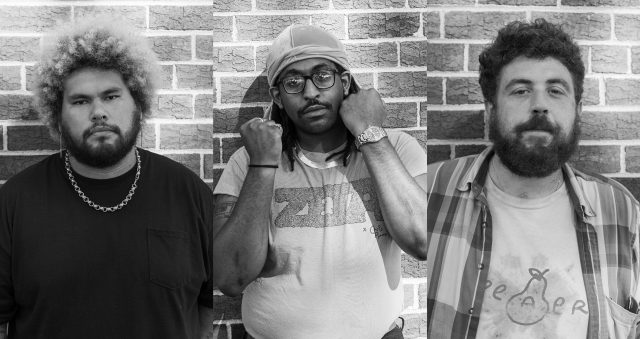
After nearly a decade grinding through the sweaty basements of the Philadelphia punk scene, it seems the rest of the world has finally caught up with Soul Glo. The fun and ferocious hardcore act started to gain real traction on their first wide release, 2020’s Songs to Yeet at the Sun, but with the arrival of last year’s full-length Diaspora Problems — the trio’s explosive and ecstatic Epitaph Records debut — the needle began to move in a whole new way.
“The thing that has changed for us is that people dance to our music now,” says vocalist Pierce Jordan. “We spent a solid seven years of people staring at us [during shows] and not knowing what they’re looking at. It was like, ‘What am I doing? This music slaps and everybody’s looking at me like I’m a fucking alien speaking goddamn Mandarin.’ Now people treat us like human beings playing music, and not a museum exhibit or some shit.”
One reason for the early slack-jawed response might have something to do with Soul Glo’s gleeful scrambling of hardcore orthodoxy. The band wrapped their arms around left-field elements like nü-metal nearly a decade before outlets like The New York Times were cranking out think pieces on its alleged Gen Z resurgence. To that end, Jordan counts two of his major vocal influences as James Brown and the late Chester Bennington of Linkin Park (“[he] was on some Freddie Mercury shit”) — a pairing that would have garnered blank stares in 2014, but has today lead the band to high-level accolades like metal album of the year from Rolling Stone.
“A majority of artists I feel spend a lot time trying to perfect their version of a sound by someone else they admire, and not enough time trying to actually say some shit they wanna say, and also put it in a way where people are gonna be like, ‘Oh yeah, that’s how I feel,’” he says. “It feels like that’s your job as an artist — not just to express yourself, but to express yourself to a point.”
On that score, there’s another reason Jordan may have felt like a sideshow in the band’s early days — having less to do with genre conventions, and more to do with the expectations placed on Black performers. Despite the early inroads made by proto-punk, hardcore and alt-rock trailblazers like Death, Bad Brains and Fishbone in the ’70s, ’80s and ’90s, aggro guitar music has gelled firmly as a “white” artform in the minds of many critics and audiences.
“I’ve always wanted Soul Glo to be a vehicle for Black people … to actualize themselves and make their lives better in whatever way they can,” Jordan says of the band’s broader reverberation in the culture. “It’s never been just about me. It’s about what we’re doing with music as artists for ourselves and the people around us.”

‘Listen, liberal’
With that racial uplift in mind, it’s not uncommon for Jordan to hear from young Black listeners who say Soul Glo’s music has opened doors that had previously seemed shut. To hear the high-energy thirtysomething tell it, these moments of personal connection among fans with a shared struggle are what it’s all about.
“It means the world every time,” he says. “I think about my inner child, and who I was when I was a teen getting into being a musician and [figuring out] how I was going to shape my musical self within who I am as a Black dude.”
But Soul Glo is about more than comforting the afflicted, as the old saying goes — it’s also about afflicting the comfortable. Consider a line from “John J,” a vicious and vulnerable heater dropped late in Diaspora Problems’ 40-minute runtime: “It’s been fuck right-wing off the rip / still liberals are more dangerous.” Instead of letting white audiences coast on the back-patting of a progressive identity, Jordan wants to cut through that complacency with the sharp edge of his cultural critique.
“I feel like a lot of liberal and left-wing people think they’re better because they align themselves with those values, even when they don’t embody or act them out at all,” he says. “You’re still comfortable living in this world, thinking one day the system is going to overturn itself. But physical choices and efforts are going to need to be made. Actions will need to be taken, as they’re being taken against us.”
Ultimately, Jordan describes the deeper ambition of the band in terms that are at once basic and bold. He says it’s not so much about chasing critical-darling status, freaking out genre purists or rattling the cages of complacent white liberals who expect a new world to be born without a fight. It’s about carving a more holistic image of the grand arc of Black life in America, one gig at a time.
“My biggest goal is making work that will be timeless and show the evolution of Black history in music and culture — how it affects individuals, and how we use that to express our lived experience,” he says. “No matter what else we mix in, it’s going to reflect that desire to show Blackness in as complete a lens as possible.”
ON THE BILL: Soul Glo with Zulu. 7 p.m. Thursday, Sept. 7, Marquis Theater, 2009 Larimer St., Denver. Tickets here.