

Tianna Esperanza equates city life to living in a pressure cooker: The concrete, the cars and the people leave no room for her to release everything she may be feeling and experiencing. Growing up on Cape Cod, access to the beach — to water — is essential for the emerging singer-songwriter and storyteller. The endless horizon gives her a sense of space and freedom, surrounded by sky and sand, as the waves gently wash her worries away. It’s where she goes to think, write and process her emotions.
“I feel free when I look out onto the water. I feel like I can bring my problems to the ocean and leave them there,” Esperanza says. “My mom used to say to me, ‘You can never be angry looking at the ocean.’”
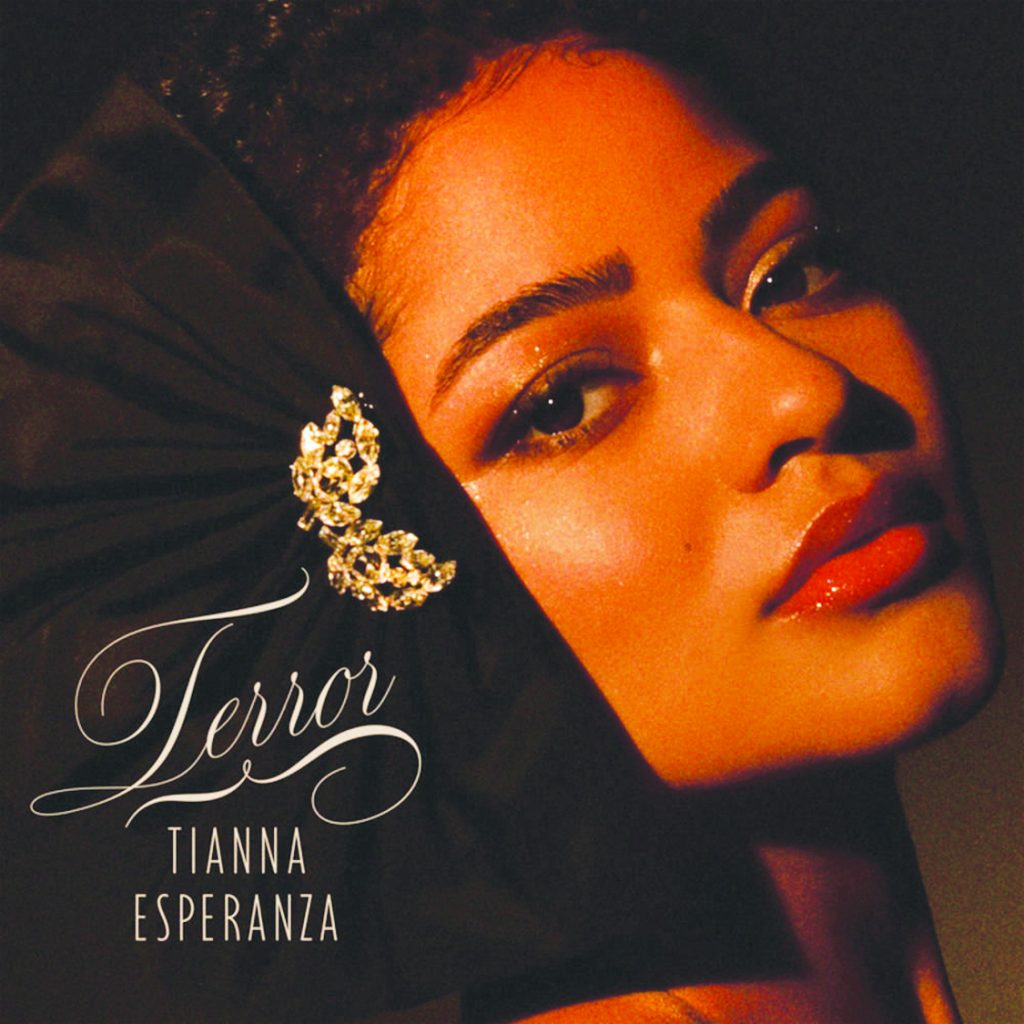
Making music is also a cathartic release for the 22-year-old artist. With her debut album Terror out Feb. 17 via Rough Trade, Esperanza defies the status quo to create something varied and versatile. With one foot planted firmly in the indie/alternative arena, the new record weaves together elements of flamenco, hip-hop, rock and soul with punk and spoken word — all deeply personal and cultural influences for the young singer of mixed race and heritage. She may have grown up in a place established as a white flight haven in the 1960s, but her childhood was anything but homogenous.
Esperanza was raised by her mom and maternal grandparents: her Scottish grandfather and Spanish grandmother, Paloma “Palmolive” McLardy, the punk drummer and innovator behind influential bands like The Slits and The Raincoats. Esperanza’s first language is Spanish and she’s a first-generation immigrant on that side. But she also has deep roots on this continent, as her father is from Georgia with African and Indigenous ancestry.
“When I talk about mixed race, I think I also talk about my mixed experience of literally feeling mixed emotion,” she says. “It’s not, ‘Oh, my mom’s white and my dad’s Black,’ you know? There’s a lot of experience and culture behind my British culture and Spanish culture and even how white Spanish culture is.”
This complex story of history and identity influences Esperanza’s music on a granular level. She makes the music that she wants, forsaking the compartmentalization of genre to showcase her influences, reflecting all of herself on every track.
“Just because there’s a song that might sound, quote, ‘Black American,’ doesn’t mean that’s a song that reflects my Blackness,” she says. “All of those songs reflect my Blackness and all of the songs reflect my Spanish heritage in their own right.”
‘The humanity of music’
Esperanza’s work is equally empowering and vulnerable — opening herself up to other people’s opinions about her own experience, even if she doesn’t always relish the public scrutiny. A haunting and raw track, the titular “Terror” touches on her younger brother’s death and surviving sexual assault. But the song has been misunderstood as an “angry lesbian” anthem, she says, demonstrating how listeners and critics can often misinterpret such deeply personal works
“I’m so proud of myself that I’m releasing something I can see is resonating with other people in its vulnerability,” she says. “And on the other hand, it’s hard to kind of sacrifice yourself on stage for strangers.”
Esperanza says it’s not easy, nor comfortable, to put herself out there, especially in an industry that often dismisses her experience and talent. Some of the same issues her grandmother faced as a female musician in the ’70s still resonate with her experience in the industry today, not to mention the dominant culture’s entitled sexualization of young Black women that she has dealt with her entire life.
On a personal level, Esperanza doesn’t believe everyone has a right to her story, but she says singing about her life authentically is the only way she knows how to create. And she draws strength from the women who have pioneered spaces before her — like her friend and mentor Valerie June, a Grammy-nominated musician from Memphis, Tennessee, who joins her on the single “Lone Child.”
“I put everything into my work and it costs a lot to do that. But I’m grateful I’m not alone in it,” Esperanza says. “And when I see women like Valerie June, I’m inspired and I’m encouraged to fight for a space [in the industry].”
People often tell Esperanza that eventually she’ll learn to blend all these influences together to create her own sound. But she resists that philosophy, saying it’s a complete misunderstanding of who she is and what music means to her. When she incorporates her grandmother’s influence in her work, is it her white experience? Her Spanish experience? Her punk experience? Or an amalgamation of it all?
“To me it’s about latching on and finding acceptance in so many different genres and finding beauty in so many,” she says. “It’s not a mixed girl sitting there with a guitar and doing white music because she doesn’t know better. It’s me embracing the beauty and the humanity of music. That’s what comes naturally to me.”
ON THE BILL: Tianna Esperanza (opening for Mick Flannery). 7 p.m. Saturday, Feb. 18, eTown Hall, 1535 Spruce St., Boulder. Tickets here.