

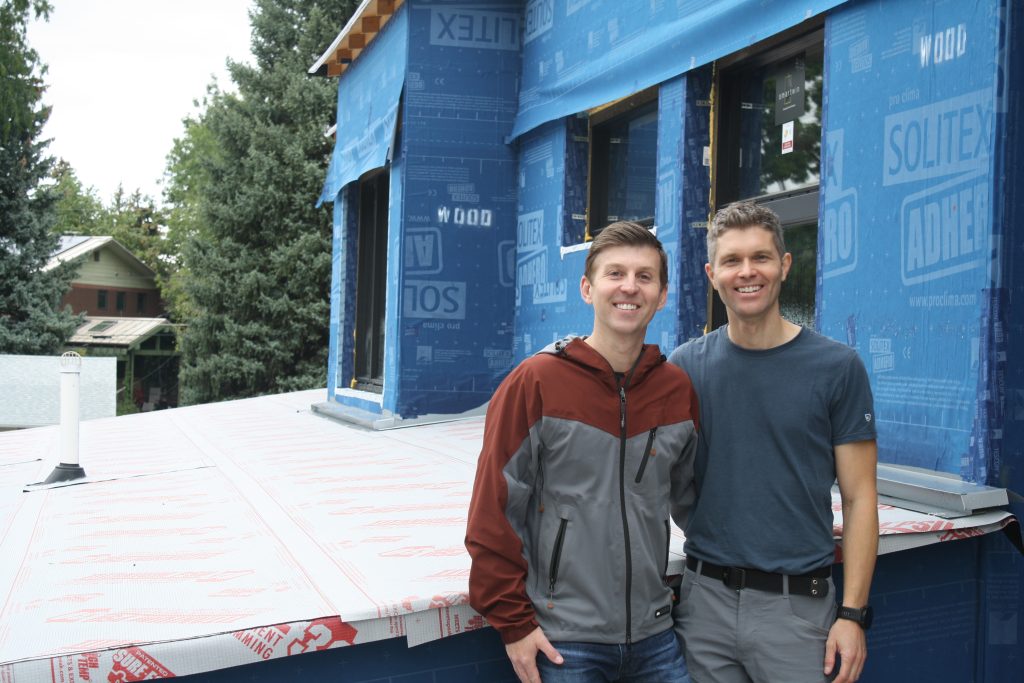
The home Matt Brill and Eric Moore are building on Forest Avenue in North Boulder doesn’t look much different than any other home construction site, aside from the fact that it’s blue instead of the typical green or white of mid-construction homes.
But step inside the home and you might notice the several-inch-thick front door or the signs that say, “No drilling, airtight construction,” and, “No cutting, airtight membranes.” The floor-to-ceiling windows throughout the house are triple-pane, and even the doggy door for their white Havanese, Finn, is being constructed to specific standards.
That’s because Moore and Brill’s five-bedroom home will be passive house certified, a green building standard that’s airtight and uber energy efficient thanks to measures like high-performance doors, continuous insulation, an orientation that makes efficient use of the sun’s heat and a ventilation system that supplies fresh air throughout the house. The couple’s home is on track to be the first certified passive house in the city of Boulder, but if trends across the state and country are any indication, they won’t be the only one for long.
Passive house buildings typically save between 75% and 90% on heating- and cooling-related energy costs, according to the Passive House Institute (PHI). The Forest Avenue home will be 100% electric, and solar panels on the roof will offset the electric usage, so Brill says they expect zero energy bills. In the similarly sized house they currently live in, the couple estimates they pay about $250 a month.
And while sustainability was a factor, Brill and Moore say that indoor air quality, quietness provided by the thick walls, and constant temperature throughout the house were what got them excited about the building practice. The couple expects to move into the home with their 3-year-old son early next year.
“It’s not just about a greener house,” Brill says. “It’s like, ‘What better quality and durability can I build into my house?’”
That quality doesn’t come without a price. Brill estimates building their home will be about 10% more expensive than a code-built residence. Ken Levenson, executive director of the New York-based Passive House Network, says construction can cost anywhere from 5% to 15% more than a code-built house, depending on the size of the project and the team’s experience. Most homeowners make up for that cost in energy savings in about eight to 10 years, Levenson says.
A growing trend
Back when Andrew Michler constructed Colorado’s first passive house in 2015, which he still lives in, he says such homes in Colorado were “as exotic as a peacock in a forest.” That wasn’t the case worldwide.
The Passive House Institute, or Passivhaus in Europe, was founded in Germany in 1996. Europe now has more than 13 times the amount of certified passive house space than North and South America combined, according to the institute. That number includes not just single family homes, but also other buildings like schools, offices and multifamily homes.
Estimates in passive house databases can be incomplete, since registration is voluntary and not everyone who builds a passive house structure decides to get it certified. One map shows four certified passive houses in Colorado. But Michler, who runs a passive house design firm called Hyperlocal Workshop, estimates there are around 20 houses that meet the standard in Colorado and about 20 more in the works. That doesn’t include houses being built to the Passive House US (PHIUS) standard – a similar, but distinct certification through what was once an approved affiliate of PHI. A messy separation between the two orgs in 2011 resulted in a different standard and pathway for certification.
Michler credits the rise in passive house building in Colorado, in part, to the realization that the state’s climate works well with the design principles and a growing network of professionals who specialize in passive house construction.
“We have lots of sunshine here, and sunshine is free heat in the wintertime, and then we have delightfully cold nights,” Michler says. “So, all we do is capture some of the heat in the day and save it at night.”
Michler says the homes are also more resilient — making them increasingly appealing as climate extremes and disasters become more common.
At least 25 construction projects in the Marshall Fire rebuild area are pursuing passive house principles, according to Passive House Rocky Mountain, a regional chapter of the Passive House Network. Those homes will be eligible for a $37,500 rebate from Xcel, the highest level of rebate the company is offering rebuilding homeowners for various energy efficiency measures. Some of those homes will be part of Michler’s RESTORE project, pre-designed “firewise” homes that meet passive house standards, pre-priced at $550,000 before upgrades and customization.
Looking forward
Many proponents would like to see passive house standards incorporated in building and energy codes, and in some places, like Massachusetts and Brussels, Belgium, that’s already a reality for certain building types.
“Passive house really isn’t the ceiling of what’s possible,” Levenson says. “It needs to be the floor of what we’re doing because it’s just providing fundamental benefits that everybody should have.”
The City of Boulder requires new builds over 3,000 square feet, like Brill and Moore’s home, to be net-zero energy. Similarly, unincorporated Boulder County has a net-zero requirement for new builds over 5,000 square feet. But Josh Hanson, the City’s energy code compliance principal examiner, says it’s unlikely Boulder would codify passive house requirements any time soon.
“Energy code is a minimum,” he says. “If you want to do passive house, that’s above and beyond and I applaud you for doing it, but every person shouldn’t be required to do that because there’s a cost to that.”
He says LEED is the most common green building certification the City sees, but that passive house certification is “head and shoulders above a lot of the other green programs, energy-efficiency programs out there.”
Like Michler, Brill hopes to be part of the growth of passive house builds across the state and has started a company, Bauen Build, to help others construct according to passive house standards. Brill says there’s already several projects in Boulder County on the horizon for his company, including in the Marshall Fire burn area.
“I think it’s just kind of moving homebuilding into that electric era,” Brill says. “As cars are evolving, I think homes need to come along with them. We still have a long way to go, but there’s glimmers of hope I’m seeing. Homeowners are asking for it, builders and architects are starting to learn about it, and I think that combination will help to propel [this standard that’s] better for the planet and better for the people living in these.”
ON THE BILL: Passive House Network Conference. Oct. 4-5, McNichols Civic Center Building, 144 W. Colfax Ave., Denver. $200-375